Growth Strategy
SEO vs Google Ads: Which Should a Small Business Start With?
Not sure whether to invest in SEO or Google Ads first? Compare cost, speed, and long-term value to decide which channel is right for your small business.
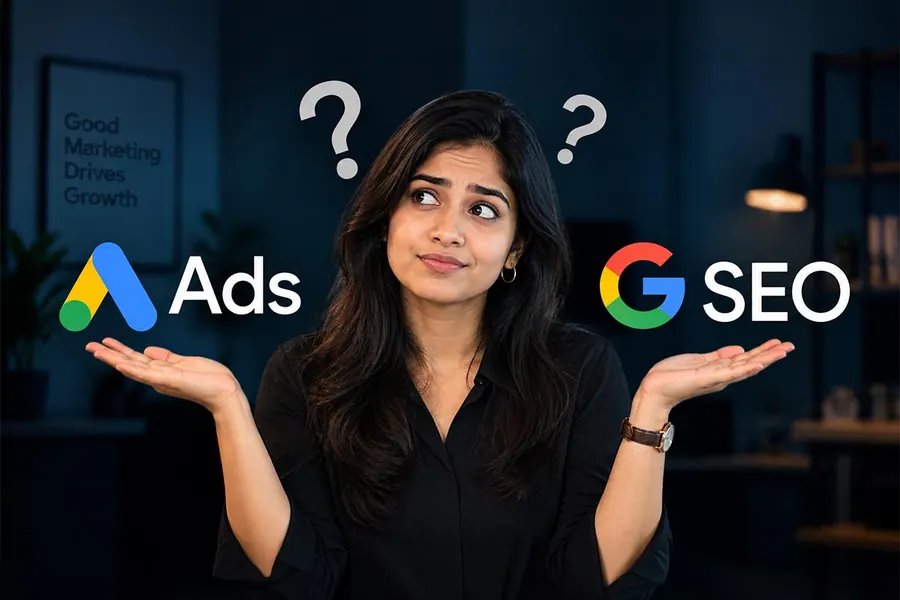
Every small business owner hits this question eventually: with a limited marketing budget, should the first rupee go toward SEO or Google Ads? Agencies often give a vague answer, “you need both”, which is true in the long run but unhelpful when you’re deciding where to start with a modest budget this month.
This post breaks down exactly how the two channels differ, when each one makes sense first, and how to think about the decision based on your specific business, not a generic rule of thumb.
The core difference: rented attention vs owned visibility
Google Ads puts your business at the top of search results the moment you turn campaigns on, and the moment you stop paying, that visibility disappears. It’s rented space.
SEO (Search Engine Optimisation) works to earn your business a place in organic search results without paying per click. It takes longer to build, but once you rank, that visibility keeps working for you without an ongoing per-click cost. It’s owned ground.
Neither is “better” in the abstract. They solve different problems on different timelines. The right starting point depends on how urgently you need customers, how much budget you have, and how competitive your industry is in search.
Google Ads: what it’s actually good at
Speed
A well-structured Google Ads campaign can start generating enquiries within days of launch. If you need customers this month, not in six months, Google Ads is the only channel that delivers on that timeline.
Control and predictability
You control exactly which keywords you show up for, what your ad says, your daily budget, and your targeting by location, time of day, and device. You can pause it instantly if something isn’t working.
A testing ground for SEO
Google Ads is also a fast way to learn which keywords and messaging actually convert, before you invest months of content effort into SEO around the wrong terms.
The catch
The moment your budget runs out, so does your visibility. Costs can also escalate quickly in competitive categories. Real estate, legal services, and healthcare in particular see high cost-per-click in Indian metros, so a small daily budget may only generate a handful of clicks.
SEO: what it’s actually good at
Compounding value
Every blog post, service page, and backlink you build continues working for you indefinitely. A well-optimised page published this year can still be bringing in enquiries three years from now, with no ongoing per-click cost.
Trust and credibility
Many customers, particularly in India, still perceive organic results as more trustworthy than ads. They associate a strong organic ranking with an established, credible business.
Lower cost per lead over time
While SEO requires an upfront investment of time or money, the cost per lead typically decreases the longer a page has been ranking, unlike ads, where cost per click generally holds steady or rises with competition.
The catch
SEO takes time, typically 3 to 6 months before you see meaningful movement, and longer in highly competitive categories. It rewards patience and consistency far more than it rewards a big one-time push.
A side-by-side comparison
| Factor | Google Ads | SEO |
|---|---|---|
| Time to results | Days | 3–6+ months |
| Cost structure | Pay per click, ongoing | Upfront time/investment, compounding return |
| Visibility once you stop | Disappears immediately | Persists (with some decline over time) |
| Best for | Urgent leads, testing offers, seasonal promotions | Long-term visibility, brand credibility, lower cost per lead over time |
| Budget flexibility | Highly flexible, scalable daily | Requires sustained monthly effort regardless of short-term results |
| Risk if paused | Visibility stops instantly | Rankings decay slowly, don’t vanish overnight |
So which should you start with? A practical framework
Start with Google Ads first if:
- You need customers within the next few weeks, not months
- You’re testing a new product, service, or location and want fast market feedback
- Your business has a seasonal window (festive sales, admission season, a limited-time offer) where you can’t wait for organic traffic to build
- You have a converting website already and just need traffic to send to it
Start with SEO first if:
- You have a longer runway and aren’t under pressure for immediate leads
- Your industry has high cost-per-click, making ads expensive relative to your margins
- You’re building a business you expect to run for years, where long-term compounding visibility matters more than an immediate spike
- You already have some content or domain history to build on
The honest answer for most small businesses
Run both, but not necessarily starting on day one with equal investment. A common, practical approach for a business with a limited budget: start with a small, tightly targeted Google Ads campaign to generate immediate leads and validate messaging, while simultaneously beginning SEO work in the background, since SEO’s slow start means the earlier you begin, the sooner it starts paying off. By the time your ad budget starts feeling stretched, your organic traffic should be starting to pick up the slack.
Common mistakes businesses make with this decision
- Choosing based on price alone. SEO isn’t “free”. It costs time, content, and often a monthly retainer. Comparing it to ads as if one is free and one isn’t leads to unrealistic expectations.
- Running Google Ads without fixing the website first. Sending paid traffic to a slow, unclear, or poorly designed website wastes ad spend that better SEO or web design work would have protected.
- Abandoning SEO after 6–8 weeks because it “isn’t working”, when 3–6 months is a realistic minimum timeline.
- Running Google Ads with no tracking, so there’s no way to know which keywords or ads are actually generating real enquiries versus just clicks.
- Treating the two channels as competitors for budget rather than as complementary. The keyword data from ads can directly inform which pages to prioritise for SEO, and vice versa.
How Heylix Media approaches this decision
At Heylix Media, we don’t default every client into the same channel mix. We look at your industry’s competitiveness, your timeline for needing leads, and your budget, then recommend a realistic starting point, often a blended approach that uses Google Ads for immediate results while SEO builds in the background. If you’re trying to figure out where your first marketing rupee should go, get in touch for a free strategy consultation.
Frequently asked questions
Can a small business do SEO and Google Ads at the same time?
Yes, and for most small businesses it is the most practical approach. A small, tightly targeted Google Ads campaign brings in enquiries now, while SEO builds in the background so organic traffic can take over part of the load in the months that follow. The key is to start ads small and increase spend only once you can see which keywords produce real enquiries.
Is Google Ads a waste of money if I already rank well organically?
Not necessarily. Ads can still win extra clicks on high-intent searches, protect your brand name from competitors bidding on it, and promote time-bound offers that organic listings cannot. Check the search terms report: if paid clicks are mostly people who would have clicked your organic result anyway, reduce spend on those terms and redirect it to searches where you do not rank.
How much should a small business budget for Google Ads to start?
Start with an amount you can run consistently for at least a month without pausing, because campaigns need data to optimise. The right figure depends on the cost per click in your category and city, so estimate how many clicks you need to get one enquiry and work backwards. Our guide to setting a Google Ads budget walks through that calculation step by step.
Does running Google Ads help or hurt my SEO?
Neither directly. Paying for ads does not raise or lower your organic rankings. Indirectly, ads help SEO by showing you which keywords and messages actually convert, so you can prioritise those topics for your organic pages instead of guessing.